You, Your Parter, & Your Partner's Porn
Porn in Relationships: How to Navigate Conflict, Trust, and Intimacy
Like so many articles about human worries, I’ll say this right off the bat: You’re not alone.
Not only are you not alone in the context of modern relationships, but centuries (1, 2) of historical hearts also go out to you as you try to make sense of the impact of sexually explicit materials. For a lot of people, it’s a charged topic giving off sparks that threaten safety, trust, confidence, and shared values and morals.
If porn is a point of conflict in your relationship, this post is here to help you do two things:
- Make sense of what’s happening without shame or panic.
- Take practical steps toward clarity, repair, and alignment with yourself as well as with your partner.
This post is not here, however, to tell you what to believe or whether pornography is a "bad" thing or a "good" thing. There are plenty of other venues for that debate. This post is about getting accurate information and strategies to help you develop a shared understanding, communicate about it, and decide what’s healthy for your relationship.
Here’s an important truth: It’s rarely just about porn.
Some recent studies have suggested that about 1 in 5 couples name pornography as a point of contention in their relationship, but pornography doesn’t tend to become a relationship crisis simply because it exists. At least one other study has indicated that "satisfaction measures tended to be highest among couples in which both partners either used pornography at a high frequency or did not use pornography at all. (3)”
Simply put, relational distress depends on the context in which porn use happens.
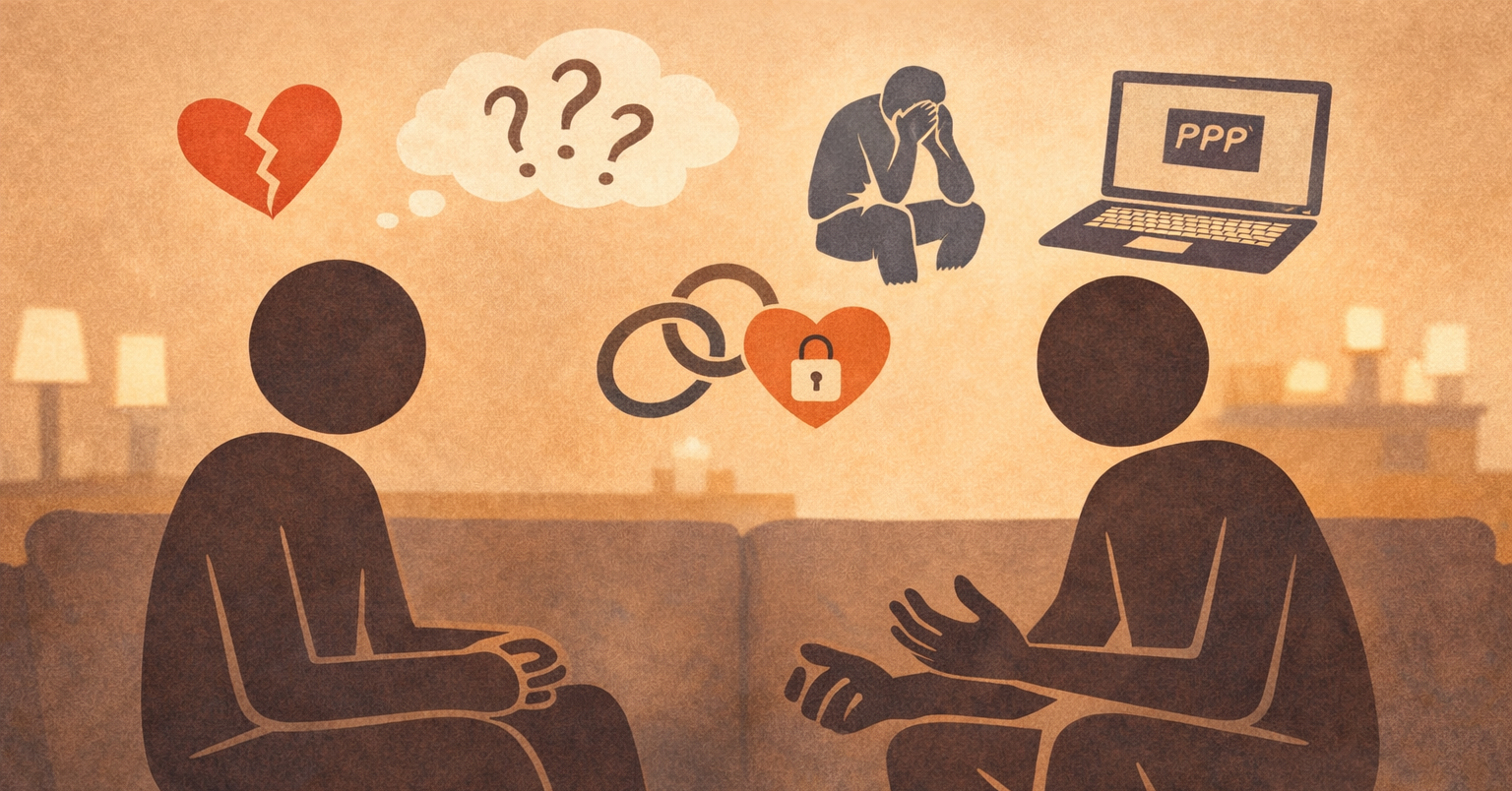
Relational ruptures where porn is involved tend to include secrecy, shame, fear, relational disconnection, porn as a coping mechanism, values mismatch and moral distress.
- Secrecy, like hidden accounts, minimizing, or deflecting. Importantly, couples often differ in their perception of secrecy vs privacy, and relational agreements are frequently assumed rather than explicitly determined.
- Values mismatch and moral distress, such as different moral beliefs about porn, sexuality, faith, or consent and exploitation.
- Shame and fear. The user may be labeled by themself and/or their partner as “bad” or “broken” or "sick." The partner of the pornography user might worry that they are “not enough” or that they're undesirable because they don’t match what they know their partner watches.
- Disconnection from each other, stemming from stress, parenting, resentment, loneliness, unresolved conflict, desire discrepancy, performance anxiety, body shame, and more can create vulnerability to using porn more often and/or to feeling more threatened by its use.
- Coping. Using pornography and masturbation to escape, self-soothe, or avoid emotions is common, especially when other coping mechanisms are undeveloped or emotional discomfort has been internalized as intolerable.
When I work with partners struggling with pornography tension, we get to the heart of the rupture, develop effective communication, and invite both accountability and compassion in service to a resilient, trusting, and connected relationship. My aim is to help them shift from fear, secrecy, and reactivity to clarity, communication, and collaborative agreements with follow through.
Let’s clarify a couple of common beliefs that can create fear and get in the way of connection.
Porn is always violent, degrading, or abusive.
- Reality: Harmful, exploitative content exists. It’s important to name and acknowledge that. And, so does ethical, consensual content. Studios and creators who emphasize consent, clear contracts, fair pay, and performer agency are on the rise. What matters is not just the existence of porn, but whether it’s aligned with consent, values, and relational agreements. Bonus Link: Myths About Paying for Porn, Facts, & Content Vetting
Porn is addictive.
- Reality 1: When people describe themselves as “addicted,” it's about distress, not a medical diagnosis. It's shorthand for feelings like shame, loss of control, fear, or conflict in a relationship. The concern deserves to be taken seriously, and it also needs to be explored in the context of the user's life experience and belief systems.
- Reality 2: To date, the accumulation of neuroscience evidence does not support pornography as an addiction because researchers haven’t been able to clearly tease correlational factors apart in a way that indicates unquestionable reliability and validity to addiction claims. That's a mouthful, isn't it? What I'm saying is, problematic use can look like addiction, but the bulk of research shows a relationship between porn and problems, not cause and effect.
Porn inevitably destroys intimacy.
- Reality 1: Porn does not automatically replace partnered sex or intimacy. What predicts harm more consistently is secrecy, shame, and disconnection, not porn itself. It’s common for couples who talk about it openly (without rigid defenses) to report less harm, and sometimes even improved communication and intimacy.
- Reality 2: Desire and intimacy are influenced by stress, mental health, resentment and disconnecting relational cycles, fatigue, pressure, and emotional safety. Generally, exploring and understanding the broader context around intimacy and porn use is fundamental for reconnection.
- Reality 3: Porn is entertainment. It’s produced, edited, and literally performative fantasy by design. Without media literacy and self-acceptance, porn can absolutely contribute to unrealistic expectations that can get in the way of intimacy, but not inevitably. Fantasy also isn’t always or necessarily meant to translate into real life. People frequently enjoy fantasizing, but making it happen in real life is a whole other topic.
*If after all this, you realize you either have a partner or ARE a partner who holds deep, unyielding resentment about someone failing to look, sound, or behave like a performer on a screen– whether it’s mainstream media or porn– that perspective invites some serious unpacking, and likely a difficult decision about what kind of person you want to be with and what kind of person you want to be.
If pornography is part of a rupture in your relationship, start with these foundations to help you repair.
Choose a regulated time.
Just like going to work, running a marathon, or taking on any other high-intensity, high-energy task, make sure you are as rested and nourished as possible, and try to limit distractions and ensure you have plenty of time. To the best of your ability, pick a moment you are both more likely to stay present and open, and take breaks as needed.
- Lead with the real, vulnerable feeling
- “I feel unsafe when I don’t know what’s true.”
- “I feel rejected and compare myself.”
- “I feel ashamed and scared you’ll judge me.”
- Clarify definitions
- What counts as porn?
- What counts as secrecy?
- What feels like betrayal?
- What boundaries feel respectful vs controlling?
Understand the injury.
Problems with porn are often a symptom of something deeper: stress, disconnection, anxiety, shame, loneliness, fear of intimacy, performance pressure, or unresolved conflict. Understanding the actual injury related to pornography is the first step to healing it, and there are three general categories: Relational Distress, Moral Distress, and Behavioral Distress. This is important because mislabeling the problem can lead to ineffective interventions and “solutions,” which, all too often, lead to even more shame and more conflict.
Explore what the problem with pornography is to each of you. Ask yourselves and each other:
- Relational Distress: Is the primary wound about secrecy and betrayal, or feeling rejected or unwanted?
- Moral Distress: Is it about values mismatch, sin, or exploitation?
- Behavioral Distress: Is it about out of control behavior that interferes with daily life, relationships, or physical wellbeing?
Mislabeling relational conflict as exclusively moral distress or behavioral dysregulation risks dismissing the relational work that is necessary for relational healing.
Mislabeling moral distress as strictly dysregulation may ignore underlying beliefs and internal conflicts, regardless of a user's frequency, duration, or the logistical impact on their life. Fact: It’s common for people who use pornography LESS to actually experience MORE distress (4).
Mislabeling legitimate behavioral dysregulation as moral distress can leave functional impairment concerns unaddressed and escalating.
Create a collaborative agreement.
Healthy agreements include:
- consent, shared values, and collaboration; never coercion
- transparency expectations
- privacy and device expectations
- plans to repair if there’s a slip
- compassion, accountability, and receptivity
When to get support
It may be time to work with a therapist if:
- Secrecy or betrayal is ongoing or has created ongoing distress and distrust.
- There’s an ongoing cycle of fights, shutdowns, hostility, and resentment.
- Porn use feels compulsive or disruptive.
- There’s trauma history, shame, or deep values conflict keeping you stuck.
- Partnered sexual intimacy feels pressured, unsafe, or impossible.
- A neutral third party is wanted or needed for structure and expertise.
With that said, you don’t have to wait for problems to fester or even surface for that matter. Proactive care and maintenance help couples identify and diffuse potential landmines, not to mention manage the fallout from the ones they still inevitably stumble over.
Pornography can be one of the most emotionally charged topics couples face. It sits at the intersection of sexuality, values, safety, identity, fidelity, honesty, and trust, so you’re not alone if it brings up big emotions.
Relational repair is possible.
If you want support navigating this in a compassionate, sex-positive, research-informed way, couples therapy with an AASECT Certified Sex Therapist (like myself!) can provide a structured space to rebuild safety and create a collaborative, values-aligned plan.
For clinicians and helping professionals.
If this topic resonates with your clinical work, I offer
continuing education and
professional consultation focused on ethical, sex-positive, relational care. You’re welcome to
explore courses or reach out to learn more.
Primary Resources
Pilver, E. E. (2024). Comstock Antiobscenity Law. EBSCO Research Starters. EBSCO Information Services. Retrieved from https://www.ebsco.com/research-starters/history/comstock-antiobscenity-law
Onania: or, the heinous sin of self-pollution. (2025, December 1). In Wikipedia. https://en.wikipedia.org/wiki/Onania:_or,_the_heinous_sin_of_self-pollution
Kohut, T., Dobson, K. A., Balzarini, R. N., Rogge, R. D., Shaw, A. M., McNulty, J. K., Russell, V. M., Fisher, W. A., & Campbell, L. (2021). But What's Your Partner Up to? Associations Between Relationship Quality and Pornography Use Depend on Contextual Patterns of Use Within the Couple. Frontiers in psychology, 12, 661347. https://doi.org/10.3389/fpsyg.2021.661347
Bőthe, B., Tóth-Király, I., Potenza, M. N., Orosz, G., & Demetrovics, Z. (2020). High-Frequency Pornography Use May Not Always Be Problematic. The journal of sexual medicine, 17(4), 793–811. https://doi.org/10.1016/j.jsxm.2020.01.007